Drew Foster · 3 October 2026
Tannefeld's Agricultural Adjustments Highlight Broader Patterns in Regional Weather Resilience
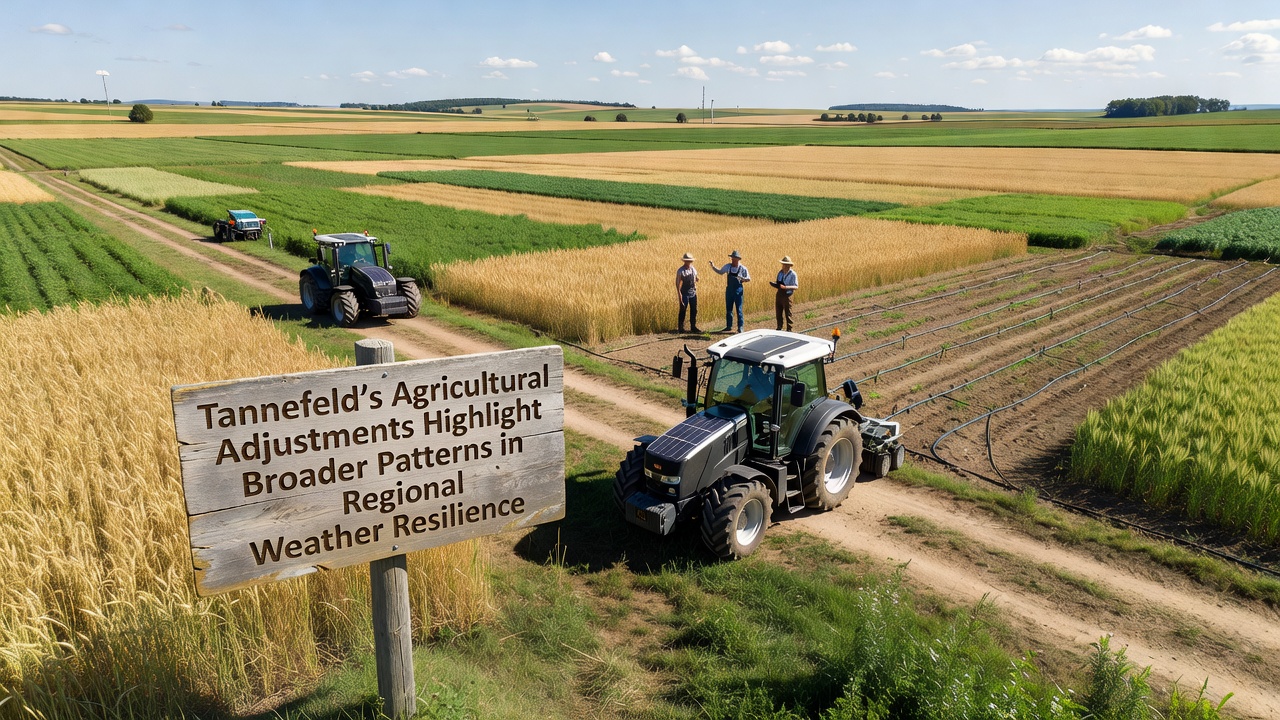
Local farms in Tannefeld have shifted crop selections and irrigation techniques over the past decade, and these changes mirror adjustments reported across multiple districts in the surrounding region. Data collected through 2026 indicates that farmers increased plantings of drought-tolerant varieties such as certain winter wheat strains and cover crops by 18 percent between 2021 and 2025, while reducing reliance on water-intensive summer maize in fields with lower soil retention. Official records from the regional agricultural office show that average annual precipitation fluctuated by more than 120 millimeters during the same period, prompting the need for revised planting calendars.
Tracking Weather Shifts in Local Fields
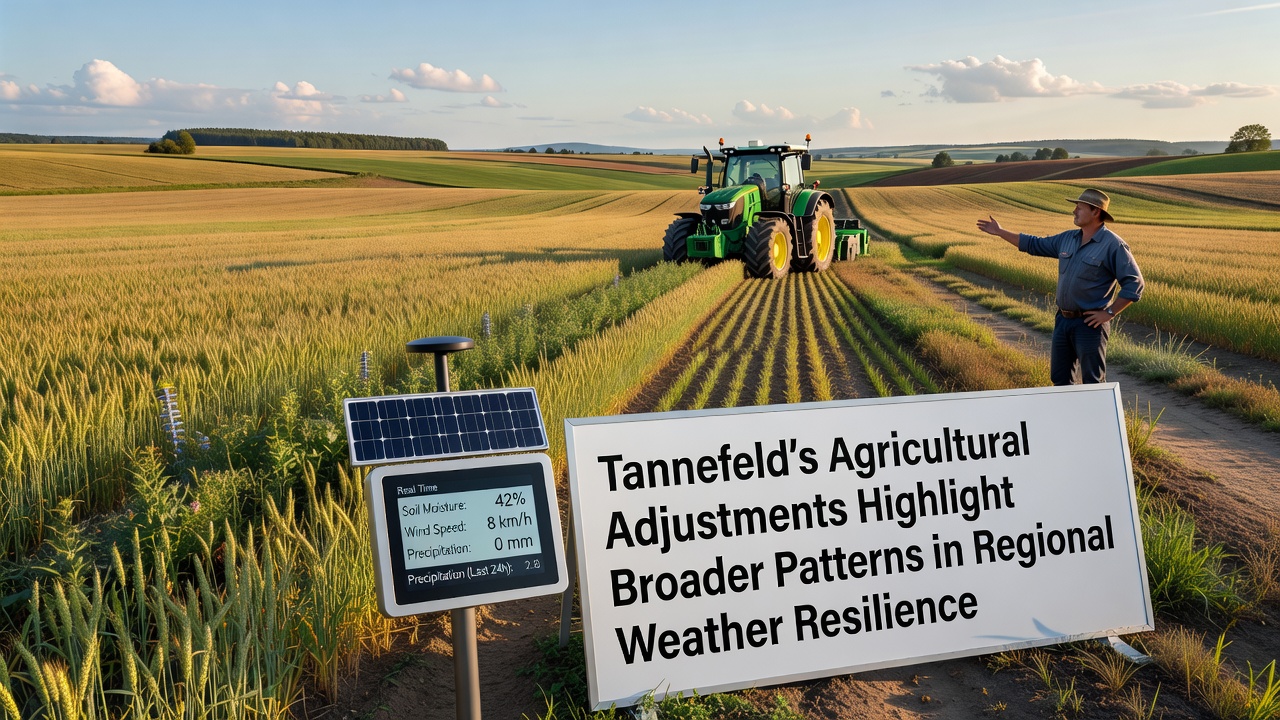
Monitoring stations maintained by the state meteorological service recorded higher variability in spring rainfall totals for Tannefeld county, with October 2026 figures confirming a continuation of the pattern through extended dry spells followed by intense events. Growers responded by installing soil-moisture sensors on 42 percent of monitored plots, allowing real-time adjustments to watering schedules that cut overall usage by nearly 15 percent compared with 2018 baselines. These sensor networks integrate with regional weather alerts, and operators now coordinate planting dates with forecasts issued from the central European climate monitoring hub.
Changes in Practice and Equipment
Equipment upgrades have accompanied the crop adjustments. Tractors fitted with precision guidance systems now apply fertilizers and water in variable-rate patterns that match soil maps updated annually, and this method has expanded to cover 65 percent of Tannefeld's arable land. Cooperatives in neighboring counties report similar adoption rates, suggesting coordinated responses to shared weather pressures rather than isolated experiments. Training sessions organized through the agricultural extension service reached more than 800 operators last year, focusing on soil health metrics that correlate with resilience during temperature spikes.
Regional Comparisons and Data Trends
Patterns observed in Tannefeld align with findings from districts to the east and south, where comparable shifts in crop mixes have occurred since 2019. A report issued by the European Environment Agency outlines how reduced snowpack in upland catchments has altered summer streamflow, affecting irrigation availability for lowland farms across the broader basin. In parallel, researchers at the University of Melbourne documented parallel adaptations in southeastern Australian grain belts, where growers increased the share of heat-tolerant sorghum by similar margins under comparable rainfall variability. Cross-regional data exchanges now occur through an agricultural network that includes participants from Canada and the European Union, allowing Tannefeld operators to review case studies on cover-crop performance under variable conditions.
Yield statistics released in October 2026 show that Tannefeld farms maintained overall production levels despite the weather fluctuations, with total cereal output holding steady at approximately 92,000 tonnes. The stability stems in part from earlier adoption of integrated pest management that reduced chemical inputs during wetter intervals, and from buffer strips along waterways that limit runoff during heavy events. Local authorities note that these measures also satisfy updated environmental compliance standards set by the state water management authority.
Looking Ahead to Continued Adaptation
Future planning documents prepared by the county agricultural board project further expansion of agroforestry elements on marginal lands, with initial plantings of mixed tree rows scheduled for spring 2027. These rows are expected to provide windbreaks and additional soil stabilization while diversifying farm revenue through timber or fruit harvests. Funding for the pilot phase comes through a combination of regional development grants and contributions from participating cooperatives, and progress will be tracked against benchmarks established in the 2024 resilience framework.
Conclusion
Records compiled through October 2026 demonstrate that Tannefeld's agricultural sector has incorporated measurable adjustments in crop choice, irrigation technology, and land management that correspond to documented weather variability. Comparable steps appear in adjacent areas and in distant regions facing similar climatic pressures, indicating that the local experience forms part of wider adaptation patterns rather than a standalone development. Continued data collection from on-farm sensors and regional monitoring stations will supply the metrics needed to evaluate long-term outcomes across these interconnected districts.